Showing posts with label tmj. Show all posts

Saturday, January 28, 2012

Ear Pain and Tinnitus.

Ear Pain from Nowhere.

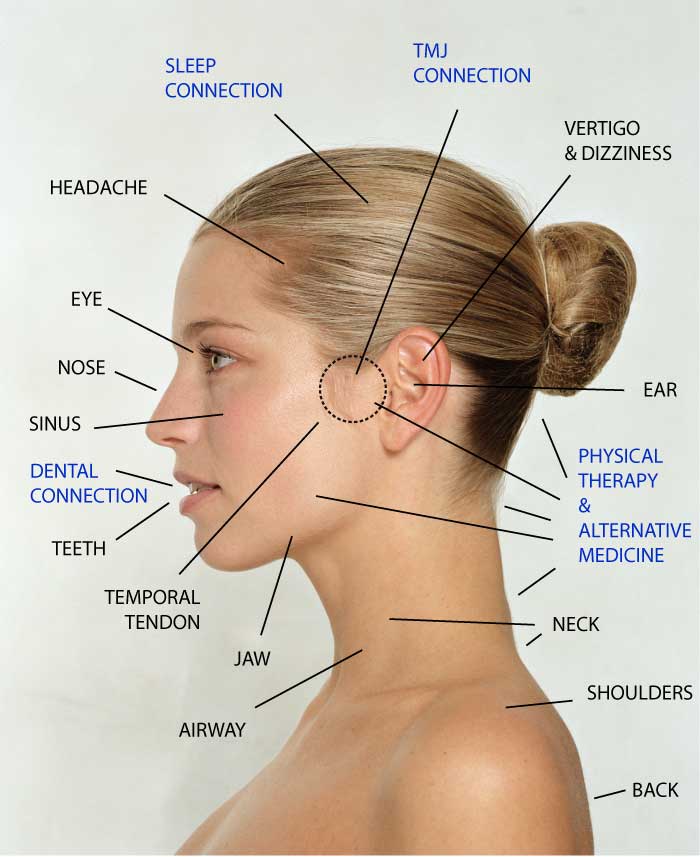
I have developed another TMJ symptom. It started as a maddening tingle around or in my left ear and progressed to a painful discomfort that appears at odd times.  I have experienced Tinnitus before but with this new symptom of mine the Tinnitus has been...well different and not pleasant. Knowing what I know about TMJ or TMD and various symptoms I figured this new and unexpected set of conditions was stress related due to several issues in my personal life.  But even knowing that doesn't make it any easier to deal with.  Deal with....just what does that mean to TMJ sufferers.  We all have to deal with our symptoms in whatever way we can but the onset of new symptoms in my case has been like a entirely new disorder that I must now cope with and find new ways to eleviate.  How frustrating and annoying it has been for me to realize I have "new" TMJ symptoms when I was doing so well.  I tried increasing my exercise but to no avail.  I tried destress technques but honestly I still felt stressed.  I guess I just hang on to my issues to hard and dont want to let go.

I visited my dentist and explained my symptoms and he suggested a mouth guard to wear at night to stop grinding of teeth.  Due to all the reading of information of sufferers and mouth guards I opted not to go this route. I did tell my dentist that I have often felt like my teeth are not as high as they used to be when I had all my "natural" teeth and that I feel this causes me to greater discomfort if I grind or clench my teeth as the TM joints are more stressed than would be if I didnt have my now many capped teeth. 
Dealing with the Tinnitus that comes with ear pain has been somewhat of a dilemma.  I try different jaw positions to see if the ringing in my ears will stop.  Sometimes it does and sometimes it does not.  But I can tell my readers that  as I usually forego any medical solution or procedure after a while I find the symptoms lessen.  Am I just deluded and have become used to them?  My answer is No.  They have subsided but not gone away.  I continued to exercise and  try relaxation techniques and told myself this too will pass.

Now  for my friends and fellow sufferers who are reading this I will say that I believeTMJ can be cured.  The human body is an amazing thing and if we have the right information and tools to keep us aligned and healthy then we can overcome practically anything.  There is a saying, " So long as we have life, we have hope!".  I believe that and nothing will convince me otherwise.  So to my fellow TMJ sufferers I say, "Do the most you can do on your best day and do the least you can do on your worst day and you will have always done your best.  And that is all anyone can ask of you".

The Best Relief for Ear Pain and Tinnitus.
For me, the best relief has come from consciously relaxing my jaw and letting it go slack as often as possible, to the point where my teeth are parted but my lips are still together.  This is hard to do but well worth the effort.  The more I do it the more it becomes natural. Of course I often find myself doing a task that requires concentration and realize that I am clenching my jaw.  This is a habit I have been working diligently to overcome and the payoff has been less ear pain and less Tinnitus. Try it.  What have you got to lose?

 A Shout Out to  Fellow  TMJ Sufferers.

We each have our own TMJ cross to bear but I want each of you to know that you have it within yourselves to control your symtoms and not let your symptoms control you.  Reach out to others and learn as much as you can about your specific TMJ condition and never do any procedure you do not feel is right for you. If you choose a path of treatment , be consistant and dont skip a step.  Be persistant and it will pay off in the long run.  TMJ has no quick fix and only the determined will get relief as they presevere along the treatment path.  Good Luck and Good Health.

Lucy Thomas

Wednesday, June 15, 2011

The Anatomy of The Temporomandibular Joint

Dem Bones.

TMJ is really the hinge that allows us to open and close our jaw. However,we commonly refer to any pain or dysfunction in the hinge as TMJ or TMD (Temporomandibular Dysfunction).  Right now we are just looking at the anatomy of the temporomandibular joint .


Let us start by taking a look at the bony structure of the TMJ or temporomandibular joint.  There are two TMJ joints, one on each side of the skull.  The name comes from the two bones that make up the joint.  One is the bone on the side of the skull called the temporalis bone and the second is the lower jaw bone which is called the mandible. Hence the name temporomandibular joint.  These joints are located just in front of your ears.  These joints are nothing more than hinges which allow us to open and close our jaw.
Between the Bones.

Surrounding the TMJ joint is a capsule of fibrous material.  Between the bone joint is a special disc which is an extension of the capsule called an articular disc which is formed from a flexible, tough yet elastic tissue called fibrocartilage  Our ears are made up of this fibrocartilage.  This thin disc divides the joint into two cavities.  When the joint is in motion or there is pressure on the articular disc it releases synovial fluid into the cavities and this fluid acts like a shock absorber and reduces friction.  There is only one other place in the body that require an articular disc and that is where the top of the sternum, clavicle and first rib all meet.  At first, when you open your mouth a rotational movement occurs with the lower jaw and the disc but when you open the mouth even wider there is a second movement called the translational or forward and downward sliding movement of the disc and the jaw.  The two ends of the mandible or jaw are called condyles which comes from the word ”condyloma” which is derived from the Greek word ”kondylos” which means a knuckle or a knob. Further, “condyle” refers to a rounded articular surface.  This knob or condyle butts up to the underneath side of the TMJ disc.  On the mandible the glenoid or mandibular fossa meets the upper side of the disc and is a depression or concave-shaped.
Joining It All Together.
Ligaments are strong, tough, rope-like connective fibres. They connect bones to each other and connect cartilage to joints.. There is one primary and two secondary ligaments of the TMJ.  The temporomandibular ligament is the primary ligament which consists of two parts; the outer oblique portion or OOP and the inner horizontal portion or IHP.  The two minor or secondary ligaments are the stylomandibular ligament and the sphenomandibular ligament of which neither is directly attached to any part of the temporomandibular joint.
During movement only the jaw moves. Muscles attached to the bones and joints allow a variety of movements.such as yawning, chewing, talking, singing, shouting and swallowing, making the temporomandibular joints the most flexible in the human body. These sophisticated joints can move up and down and side to side in a wide range of motion and in a normal healthy jaw there is no pain or discomfort with these movements.


Muscles and The Nerve of It All.
The four muscles of mastication move the jaw or mandible.  They are the masseter, the medial pterygoid, lateral pterygoid and the temporalis.  The Trigeminal nerve is the sensory nerve for the face and the motor nerve for the mastication muscles  As the name suggests, the trigeminal nerve is made up of three branches.  The ophthalmic V1, sensory, the maxillary V2, sensory and the mandibular V3,motor and sensory branches.
TMJ Disorders, Pain and Discomfort.
Muscle fatigue from clenching the jaw or grinding your teeth, arthritis, and jaw injury are some of the causes of TMJ disorders. Understanding the anatomy of the joint will help you to better understand the workings of the TMJ and how surrounding bones,ligaments, nerves.and muscles can be affected when you experience temporomandinbular disorder.


****************************************************************************************************
Discover How Sandra Carter, a nutritionist, health consultant and former TMJ sufferer from California permanently cured her TMJ and bruxism by clicking here!

Sunday, January 23, 2011

TMJ AND IMS: My Success Story

TMJ and Me.


I am a TMJer. At 57 years of age I consider myself to be lucky. Why?

Because I haven't had severe or chronic TMJ problems and have been pain free relatively speaking for many years. I say "relatively speaking" because in hind sight I realize that frequent migraines, headaches, neck pain, shoulder pain and head and jaw pain came from my TMJ disorder.  My TMJ causes were mainly stress and poor posture so I consider myself lucky not to have any trauma  or degenerative joint or dislocation of the joint or arthritis of the TMJ joint.

A Little of my TMJ History

I never knew I had a TMJ problem until the early 70's when I was barely in my twenties and I began to have severe sharp pains in my right ear. My immediate thought was that I had an ear infection but the sharp pains would come and go. I had always known that my jaw didnt open and close evenly but it didn't give me any discomfort and so was just a fleeting thought that I had a mild physical oddity. As quickly as I noted it I forgot about it.

Then came the ear aches. Acute and for seemingly no reason. I felt well enough so how could I have an infection? After a few days of off again on again pain I visited my doctor. I was examined and checked for fever and he looked in my ears. Finding nothing the matter he referred me to an ENT (Ear, Nose and Throat) Specialist.

I don't recall his name but I do recall how quickly he arrived at a diagnosis. Of course he had my GP's report, so he put his fingers in my ears and asked me to open and close my mouth slowly. As I did this he said I had a dysfunctional something or other. He talked I listened but I guess I looked somewhat skeptical. He asked me to put my fingers in my ears and open and close my mouth as before. I felt that old uneven feeling as my chin performed an 'S' curve only this time it was fingers getting the full impact of my faulty jaw. For a brief instant I thought to myself .... Oh yeah I know I have that!....And then the realization that this was what was causing my ear aches was somewhat astounding. I was also very relieved that I didn't have an infection.

I bet you TMJer's out there are wishing right now that an infection was all you had; at least it could be cured with antibiotics. I understand completely.

It was then the doctor gave me a set of exercises to do and I still do them today. I am no expert but in the last little while I have watched videos and read up on TMJ exercises that appear to be as ineffective as they are ridiculous. Why, you ask? My reasoning ( and I am taking full writers license here) is that the jaw has about a force of 300 to 400 psi give or take. That's a lot of force and the exercises I have seen have you placing two fingers against your cheek and moving your jaw against them with pressure applied. I am sorry but that doesn't seem an effective exercise or a relative one to me. Not when you realize that the jaw can apply some incredible forces when clenching, chewing.

I have had success with the exercises given to me over thirty years ago by the ENT specialist and which I wrote about in detail on my first page" Treatments for TMJ".
Those exercises have proven valuable to me and I perform them any time I feel TMJ pain.

Major TMJ Flare-up
I cannot move my head


So it was just before Christmas and I was getting Christmas preparations underway for the visit from our daughter and our two grandchildren. As well as that, I was spending many long hours at my computer on projects that were causing me stress. So much so that I didn't notice how bad the pain was getting in my face, neck and shoulders. I admit to sitting badly in my chair. My posture is usually the first thing I forget when I am stressed.  Stress and bad posture are two major causes for TMJ jaw disorder.

With no time to spare I barreled ahead with my projects and Christmas chores. What a shock when I tried to get out of bed one morning and I could not lift my head off the pillow, there was so much pain. It wasn't just my neck that hurt, I had a pulsating pain on the right side of my head and the right side of my face felt bruised. Did I mention I was biting my nails quite a bit. Naughty me. When I finally managed to stand up by rolling over and dropping my feet on the floor I found I could not turn my head even an inch without awful pain.

IMS to the rescue.

IMS stands for Intramuscular Stimulation and I am fortunate to live in Victoria, B.C Canada and have qualified Therapists in clinics nearby.

Immediately, after one treatment I had nearly full range of motion moving my head to the right and just small amount to the left. During the week I continued to get better, the pain in my neck and shoulder decreased and then I could feel pain in my jaw and teeth I had not felt before because my neck was so bad. One week later I had my second treatment and a week after that I was almost back to normal. No jaw pain, just some soreness in my neck. I didn't need a third treatment.

I am so thankful I discovered IMS . It worked on my back when I was diagnosed with a spinal stenosis and it worked on my TMJ.


Read below the excerpt from Author Robin Shepherd of
The Institute for the Study and Treatment of Pain
IMS Practitioners in the United Kingdom

What is intramuscular stimulation (IMS)?


Intramuscular stimulation (IMS) is an effective treatment for chronic pain of neuropathic origin (see below). IMS was developed by Dr.Chan Gunn while he was a clinic physician at the Workers' Compensation Board of British Columbia. Dr.. Gunn, is currently a clinical professor and teaches IMS at the University of Washington's Multidisciplinary Pain Centre in Seattle and the University of British Columbia's Medical School. IMS is also taught and utilised at many centres around the world.
IMS is effective and has few side-effects; the technique is also unequalled for finding and diagnosing muscle shortening in deep muscles.
Although IMS uses implements adapted from traditional acupuncture, it is based on scientific, neurophysiological principles. The acupuncture needle used is very thin (much thinner than the hollow needle used to inject medicine or take blood samples). You may not even feel it penetrating the skin, and if your muscle is normal, the needle is painless.
However if your muscle is supersensitive and shortened, you'll feel a peculiar sensation - like a muscle cramp. This is a distinctive type of discomfort caused by the muscle grasping the needle. Patients soon learn to recognise and welcome this sensation. They call it a "good" or positive pain because it soon disappears and is followed by a wonderful feeling of relief and relaxation. The needle may still be in you, but because the muscle is no longer tight, you no longer feel it. What has happened is that the needling has caused your abnormal muscle shortening to intensify and then release. It is important that you experience this sensation in order to gain lasting relief.


Neuropathy - what happens when nerves start to go wrong...
Doctors usually have no difficulty in treating pain caused by injury (a fracture, for example) or inflammation (such as rheumatoid arthritis). They are perplexed however by pain that shows no sign of tissue damage or inflammation.
This type of pain, known as neuropathic pain, typically occurs when nerves malfunction following minor irritation. Nerves and nerve endings become extremely sensitive and cause innocent, harmless signals to be exaggerated and misinterpreted as painful ones.This characteristic is known medically as supersensitivity). The result is pain, even when extensive medical tests show there is "nothing wrong". Until recently, supersensitivity has received little attention in medical circles.
The effects of IMS
The effects of IMS are cumulative- needling stimulates a certain amount of healing, until eventually, the condition is healed and the pain disappears. Some patients treated with IMS have remained pain-free for over 20 years.
Frequency of treatments
Treatments are usually once a week (but can be spread out to two weeks) to allow time between treatments for the body to heal itself. The number of treatments you require will depend on several different factors such as the duration and extent of your condition, how much scar tissue ther is (this usually increases after surgery) and how quickly your body can heal. The rate of healing depends on the condition of your nerves(young people usually heal more quickly although his is not always the case). If the pain is of recent origin, one treatment may be all that is necessary. In published studies of patients with low back pain, the average number of treatments required was 8.2.
Treating neuropathic pain
Supersensitivity and muscle shortening cannot be operated on and "cut away". "Pain killers" and other analgesic pills only mask the pain. The goal of treatment is to release muscle shortening which presses on and irritates the nerve. Supersensitive areas can be desensitised and the persistent pull of shortened muscles released.
The shortened muscle syndrome
An important factor in neuropathic pain is muscle shortening, caused by muscle spasm and contractor. Muscle shortening produces pain by pulling on tendons, straining them as well as distressing the joints they move. Muscle shortening also increases wear and tear and contributes to degenerative changes such as tendonitis and osteoarthritis.

These conditions are customarily regarded as "local" conditions and may not receive the appropriate diagnosis or treatment.


IMS Practitioners

See a listing of IMS Practitioners at : http://www.istop.org/membersusa.html

TMJ and You
Dont Despair, Options are Here.

There are many TMJ treatment options for you to consider. Start with the conservative approaches and work your way through them. Give yourself lots of time to see if the treatment is working and be honest with yourself about the effort you are putting into following the treatment program.

Take care, TMJers. Wrap up with your gel packs and heat bags and find the treatment that works for you. Ask lots of questions and get several medical opinions before having any surgery.

IF IMS IS NOT FOR YOU THEN TRY A HOME REMEDY TRADEMARKED "TMJ NO MORE" AS IT HAS HELPED THOUSAND OF PEOPLE WITH TMJ. Click Here!
TO FIND OUT MORE.


*******************************************************************************

Thursday, January 13, 2011

Tips for treatment of TMJ.


Hi my name is Lucy .  I live on the West Coast of  Canada and I am fifty-seven years old and I love sailing , painting and gardening.

I found out over 35 years ago that I had TMJ when I went to my Doctor  about an earache.  When he couldn't find any infection he referred me to an Ear, Nose and Throat Specialist.  It sounds funny but the Specialist had me stick my fingers in my ears and open and close my jaw.  It was then I felt my jaw clunk unevenly and Temporomandibular Joint Disorder was the name he gave me for the sharp pain in my ear. TMJ causes this symptom along with many others. I needed TMJ or TMD treatments.

I was given some stretching and resistance exercises  to do and was suggested I take some muscle relaxants and avoid eating things like Big Macs.  I was interested in what had caused this and was told that it could have been dental work (some of which I had done recently) or it was stress related;( also a possibility) as stress can be one of a number one tmj causes.
It wasn't until recently that I became very very interested in TMJ jaw disorders after I experienced a wicked episode of neck pain, shoulder pain, jaw pain and head pain that sent me in search of some serious help for the pain TMJ was giving me.

What is TMJ Disorder?


TMJ disorders (TMJD) cause pain and tenderness in the TemporoMandibular joint (TMJ) — the joint just in front of your ears on either side of your head where your lower jawbone meets your skull. It is by far the most complex and most over-worked joint in the human body.
TMJ jaw disorders can be caused by many different types of problems — TMJ causes are often very individualized and there is a long list of causes including arthritis, jaw injury, or muscle fatigue from clenching or grinding your teeth.
In most cases, the pain TMJ causes and the discomfort associated with TMJ disorders can be alleviated with self-managed care or nonsurgical treatments. About 5% of all TMJ cases are severe, such as TMJ dislocation and may need to be treated with dental or surgical interventions. TMJ surgery should be a last resort and your decision to have TMJ surgery should be arrived at with the help from a TMJ specialist.


Symptoms of TMJ

- Headaches, migraine headaches.
- Jaw locks opened or closed.
- Ringing or buzzing in the ears.
- Hearing loss.
- Problems swallowing.
- Neck pain and shoulder pain and back pain.
- Stiffness in jaw joint.
- Inability to open mouth wide.
- Inflammation, swelling.
- Clicking and popping sounds.


Types of Treatments for TMJ.


There are many  treatments  for TMJ that range from very passive of exercises to the extreme of invasive surgical procedures.

Exercises.  Ranging from passive movements to stretching and resistance.

Diet and stress management.

Medications.  Anti-inflammatories, muscle relaxants. 

Mouth appliance or Splint             

Corrective dental procedures.

 Physiotherapy.

Acupressure.

Transcutaneous electrical nerve stimulation (TENS).

Ultrasound.

Botox treatments.

Trigger-point injections and Radio Wave Therapy.

Acupuncture

Prolotherapy _Injections of an irritant to stimulate repair of ligaments and  tendons.

Surgical intervention.


Easy Exercises to help relieve TMJ.

These TMJ exercises below were given to me as a simple ways to reduce TMJ pain.  Do them in the privacy of you own home.  Done regularly, you can expect to have increased movement in your TM joints and more relaxed muscles. Start with 3 repetitions and increase over time to 10 repetitions.

 1. First, with  mouth closed place the palm of your hand under your chin and creating resistance with your hand slowly open your mouth wide.  Now that mouth is wide open place two fingers of the same hand on the lower teeth, then slowly close the mouth again using resistance. Go slowly and be gentle. Do repetitions.

2. This exercise is similar to 1.  except you  thrust your jaw straight forward with the palm of you hand  against the chin giving resistance.  Once the jaw is fully extended place two fingers of the hand on the lower teeth and now using resistance pull the jaw straight back to its resting position. Do repetitions.

3. Make a fist with your left hand and place flat side of your fist against the left side your jaw.  Using resistance slowly move your jaw to the left, once fully extended to the left place a right hand fist against the right side of jaw and using resistance move the jaw all the way to the right. Do repetitions.

4. Gently close your mouth and touch the roof of your mouth with your tongue.  Hold  the tongue on the roof of your mouth as you slowly and gently open and close your mouth. Do repetitions.

One important thing to note: if you have severe TMJ symptoms, it is always a good idea to consult with a doctor in order to determine the best treatment plan. These exercises may be helpful to relieving the pain, but there may be other treatments to consider as well.

If you do these exercises daily it will increase flexibility  the joint and also strengthen and help to relax the jaw muscles.  These TMJ exercises can greatly alleviate the pain and discomfort associated with TMJ, and contribute the the healing of this disorder.

NY Times Article Best Treatment for TMJ May be Nothing, worth a read at http://www.nytimes.com/2009/02/03/health/03brod.html

***************************************************************

A wonderful program to try for those of you seeking relief from TMJ pain is
TMJ No More
A Natural Remedy for TMJ that has helped thousands of men and women.

****************************************************************


Linking Pages

Your smile says a lot about you. Get oral health information, news and treatments for TMJ,TMD and many oral health issues.


***************************************************************