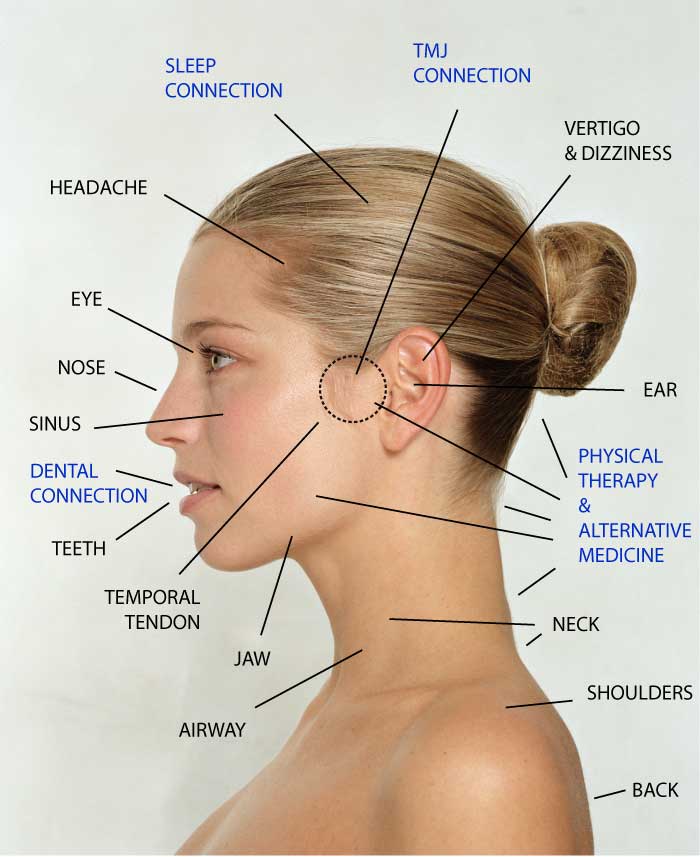
Does this sound like you?
You feel as if your head is about to split open, like someone has hammered a spike into your eye, your temples throb,you are nauseous,you have tooth pain, your neck and shoulders and back hurt, then it is more than likely you have TMJ.
Whether your headache is a severe migraine headache or a tension headache and you have tried various treatments to no avail and no-one has suggested TMJ as a diagnosis it is because your practitioners you have been seeing have not been schooled in the relationship between head pain and TMJ. In fact, there are many practitioners and specialists that are skeptical of the relationship between TMJ and head pain. The good news is that there are TMJ specialists out there who can diagnose your TMJ and recommend or provide the correct therapy for your TMJ disorder.
Now you may be someone who already knows they have a TMJ disorder and that your headaches are merely a symptom of that disorder or you have suffered from migraine headaches for some time and are now discovering that TMJ is the cause. Whichever it is you can be sure there are treatments available for your headaches. But first, let us look at the different types of headaches and how to recognize them by their symptoms.
*******************************************************************
There is a cure for TMJ. Be free from your PAIN using these Natural Holistic Steps. This remedy has worked for Thousands of men and Women. Dont miss out! CLICK HERE.
********************************************************************
Headaches types.
So you have TMJ and one of the symptoms is headache or migraine headache. This type of headache is known as a secondary headache.
Secondary headaches are recognised as being caused by an underlying condition. In this case, the underlying condition we are discussing is TMJ.
According to the Mayo Clinic there are three common headache types:
Tension headache, which can last from twenty-five minutes to an entire week and manifests as dull pressure on both sides of the head and sometimes also the neck and may also include fatigue and a feeling of a rigid band circling the head with pressure and tightness. Tension headaches can reoccur daily to very infrequent.
Migraine headache, which can last from four to seventy-two hours and is moderate to severe throbbing pain and can be located on one side or both side of the head. The frequency of recurring migraines varies greatly. Symptoms can include nausea,vomiting,sensitivity to light, smell and sound and pain will increase with physical activity.
Cluster headache, which is sharp, severe pain that develops suddenly over a matter of minutes and is located on one side, often around the eye or behind the eye and can last anywhere from fifteen minutes to three hours. Included symptoms are runny nose, nasal congestion, teary eye on one side, red eye and feeling agitated. The frequency of this type can be one or more every day during "clusters".
Why do TMJ Headaches Happen?
TMJ Headaches are due to the involvement of the trigeminal nerve which is located on the side of the head is one of the most powerful and complex nerves in the human body. It innervates the jaw, teeth,eyes,tongue, palate lips, sinus and face so it it has a close association to the TMJ. Certain areas of the brain are also innervated and controlled by the trigeminal nerve. In fact, it is estimated that the brain uses an astounding 40% of its energy figuring out the messages from the trigeminal nerve and sending messages back through the nerve. The trigeminal nerve is also linked to other nerves that control sensation and function of most other muscles in your thoat, neck and head; the vagus, facial and hypoglossal nerves. A disturbance in any one of these four nerves will end up distrubing the other three. Along with TMJ symptom of headaches it is not uncommon to experience issues like burning tongue, burning thoat, blurry vision, problem swallowing and difficulty breathing.
When is Your Headache NOT TMJ related?
While doctors are beginning to realize that most tension headaches are caused by TMJ it is still very important with any type of headache that you see your doctor for a diagnosis. If a physical examination does not reveal the cause of your headaches then you should have a neurological examination to rule out critical conditions such as West Nile virus.
A sudden, severe headache can be due to brain tumor or cerebral aneurysm or meningitis or virus. Please seek immediate medical attention!
Headaches are also a symptom of flu, fatigue, hypertension, eyestrain, fever, sinus problems and ear problems. So get a diagnosis so that you can eliminate receive the dangerous disorders and receive the proper treatment for your headache.
Home treatments for TMJ headaches.
As soon as you feel a TMJ headache coming on try these remedies.
Lie in a dark, quiet room that is free of any odors that can aggrevate your headache.
Lie on a cold pack placed at the back of your neck for 10 to 15 minutes. A hot compress at the back of the neck will reduce muscle tension. I have even tried both hot and cold simultaneously; cold to back of neck, heat to forehead, temples. That is my preference. You can switch it around if you prefer.
Try to relax your face and jaw by yawning. If you pretend to yawn trust me you will eventually yawn for real. It will reduce muscle tension. Do your jaw or TMJ exercises.
Essential oils such as peppermint oil or lavender oil rubbed at the temples or on neck can help you to relax and breathe freely as sinus and breathing problems often happen at the same time as your headache.
If you feel up to it and you have someone you trust, try having them give you a massage. Focus on neck, shoulders, back and temples.
In case you are dehydrated drink some water.
Practise relaxed breathing and do a systematic "tense and relax" routine on your body starting with your feet. As you lie quietly tense up your feet and toes as much as you can for 4 seconds then let go the tensed muscles and relax the feet until you feel them comletely relax. Work your way up your calves, thighs, hands, arms, abdomen, shoulders, neck and face doing the same "tense and relax"
procedure. This is a great way to relieve yourself of stress at any time and it can be done to help you fall a sleep at night.
Drink a strong cup of coffee. Caffeine can help to relieve headaches as it reduces blood vessel swelling and that is the reason it is an ingredient in some pain medications.
Take an over-the-counter medication. Talk to your doctor about which is best for you and how often you can take the medication since prolonged use of analgesics can cause stomach problems and bleeding and even increase the risk of heart problems. Four such analgesics are Acetaminophen (Tylenol), Ibuprofen (Advil, Motrin), Aspirin, Naproxen(Aleve).
You can also read the list of possible home remedies to try on Tips for Treatment of TMJ.
Medical Treatments for TMJ Headaches.
Medications: - Your doctor can prescribe a medication that will work to either prevent a migraine or headache as it starts or prescribe a medicine to reduce the number or frequency of your headaches.
Triptans are a group of drugs used to prevent the onset of a migraine headache and they target seratonin. They include brand names such as Imitrex, Zomig ,Amerge, Maxalt, and Relpax.
If the triptans do not work for you then there are other drugs your doctor may prescribe such as Cafergot, D.H.E. 45 injection, Migranal Nasal Spray, Midrin, Compazine and Phenergan.
If you suffer from severe migraine pain your doctor may prescribe a narcotic such as Vicoden or Tylenol with Codeine No. 3.
Botulinum Toxic (Botox) is now being used to successfully relief headaches.
Physical Therapy
Acupuncture
IMS (Intramuscular Stimulation)
Mouth Splint or night guard or NTI.
Things You Can Do to Reduce TMJ Headaches.
Get plenty of sleep.
Stop smoking.
Eat healthy meals.
Drink plenty of water. 6 to 8 glasses of water per day.
Learn Yoga or relaxation techniques.
Avoid stressful situations.
Do regular jaw exercises.
Practice good posture.
Try a soft food diet.
Resource Links
American Headache Society
Academy of Neurology
International Headache Society
Migraine-Headache Resource Center
National Headache Foundation
National Institute of Neurological Disorders and Stroke
***********************************************************
Amazing all-natural TMJ breakthrough permanently eliminates TMJ without drugs or surgery. Stop wasting money on pills, potions, and other worthless quick fix cures… Learn the truth about TMJ once and for all and finally get the TMJ freedom you deserve: CLICK HERE!
***********************************************************